FERRYING THE FUTURE: UC BERKELEY TO NASA AMES TRANSIT PROPOSAL
Abstract
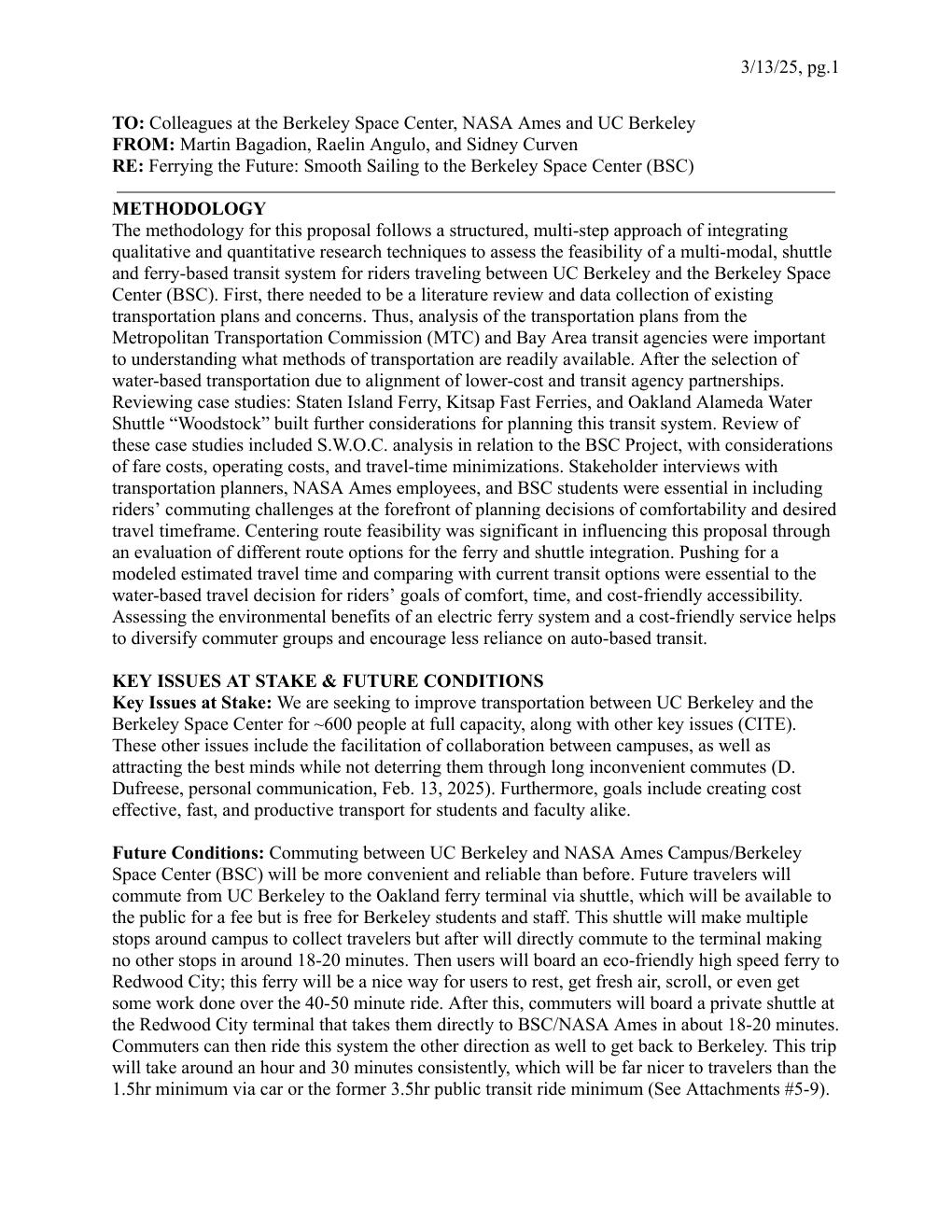
Daily commutes between UC Berkeley and NASA Ames' Berkeley Air & Space Center development (about 46 miles) take 1.25–4.5 hours via car or public transit. High costs, traffic congestion, and unreliability on transit routes to the South Bay hinder collaboration and talent attraction for the projected 600 users (interns, employees, NASA and UC Berkeley staff). My role as a team researcher included analyzing current conditions, policy contexts, and various ferry-based case studies to propose a medium-term ferry-shuttle system. The memo delivered feasible recommendations for NASA Ames to implement a route that aligns with the WETA 2050 Vision for a Tier 1 Oakland–Redwood City ferry route. I also proposed a solution for first/last-mile issues by following an existing shuttle system for Berkeley Labs to access the ferry terminal, cutting travel time and alleviating costs and emissions.
Actionable Methodology
- 01Start by defining a narrow decision frame: what question must the memo answer and who will read it, then build every section to serve that frame; here, the decision was whether NASA could justify a ferry-shuttle investment, so current-condition mapping, policy alignment, and case-study benchmarking were selected to directly support a yes/no/feasible timeline conclusion
- 02Treat stakeholder interviews as structured evidence, not anecdotes: design open-ended prompts around cost, time, and reliability pain points, then code responses into comparable categories (private car, public transit, ideal scenario) so the memo can quantify commuter burden rather than describe it
- 03Anchor every recommendation in multiple policy layers, operational (UC Bear Transit), regional (WETA 2050), and programmatic (BayPass), to show alignment and flag conflicts; this makes the memo defensible to legal, planning, and finance reviewers who each use different frameworks
- 04Use case studies as controlled experiments, not illustrations: extract standardized criteria (service frequency, first/last-mile integration, capital vs. operating cost, equity outcomes) from each so they can be scored against the project's own constraints; Seattle–Bainbridge validated high-frequency potential, Staten Island proved subsidy models, and Woodstock–Oakland showed how to solve terminal access with a small shuttle
- 05Write memos for layered audiences: an executive summary for decision-makers, methodology appendix for technical reviewers, and a timeline with named responsible parties for implementers, so one document can travel across departments without being rewritten