A GHOST SHIP IN A LIVING CITY
Abstract
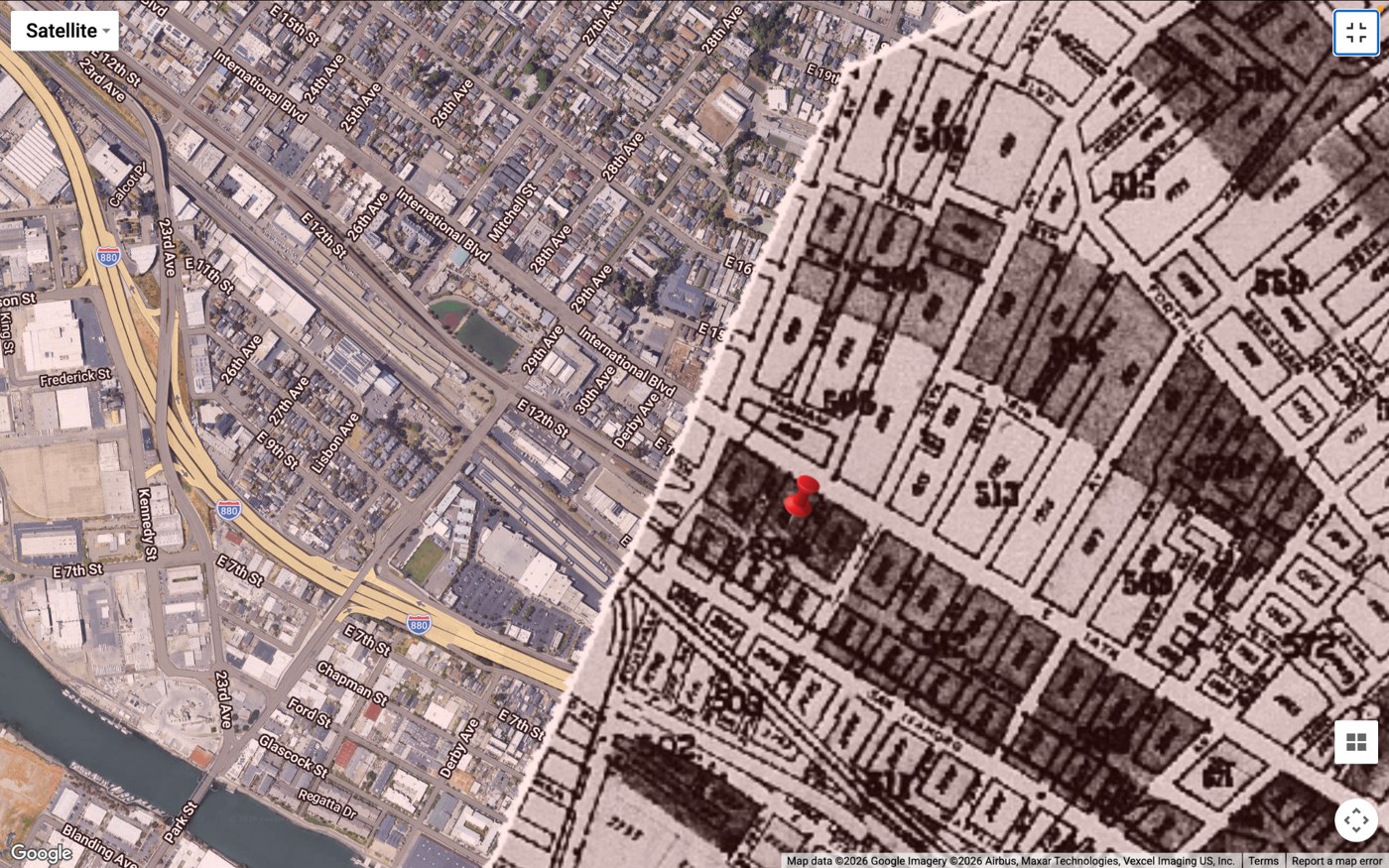
"A Ghost Ship in a Living City" is a site exploration of the Ghost Ship Warehouse in Oakland's Fruitvale District, an illegal artist live-work collective lost to the 2016 warehouse fire, on a site that now sits as a fenced-up dirt patch. Because the building no longer stands, the study treats its absence as the subject: examining how the warehouse's "success" both responded to and was bounded by the socioeconomic conditions of its tenants, offering affordability and collectivization for artists displaced by gentrification at the cost of safety. The research asks whether the built environment creates and responds to socioeconomic conditions or is bounded by them, arguing that structural failures and fatalities fall on socioeconomically oppressed groups barred from the spaces that grant them physical and emotional safety. The analysis is grounded in map interpretation, layering a 1925 Sanborn fire insurance map over the present-day satellite view to tie the site's current condition to its past.
Actionable Methodology
- 01Developed mapping analysis skills by interpreting large-scale Sanborn fire insurance maps, reading orientation, scale, and key-sheet conventions to extract insights on Oakland's development and planning patterns from maps not designed for the average viewer
- 02Built the ability to read and research archival map collections, navigating hundreds of Sanborn sheets and volumes across databases like Fire Insurance Maps Online and Digital Sanborn Maps, using changed street grids and landscape markers like Sausal Creek to locate a site from the previous century
- 03Learned to use redlining, Sanborn, and policy maps as layers that tie the current history of cities and buildings to their past, connecting a 1925 insurance map to the present-day dirt lot to show how historic urban frames continue to shape urban safety
- 04Gained a better understanding of building codification: how the Ghost Ship's unlicensed, unpermitted construction enabled its community function while its lack of code-compliant safety systems made it lethal, revealing code as the line between informal space and protection
- 05Recognized how archival research itself is bounded: informal spaces face greater chances of erasure in academic databases, so mapping practices became a method for recovering sites that photography and news archives overlook
Context
The Ghost Ship Warehouse in East Oakland's Fruitvale District was an illegal artist live-work collective where roughly twenty artists paid around $700 a month, nearly half of Oakland's going rate, to live and work in a maze-like space of unlicensed construction. After the December 2016 fire killed dozens of attendees at an underground concert, the building was demolished, leaving a fenced dirt lot. The tragedy exposes how the principle of land value, reinforced by redevelopment pressure like Oakland's 10K Initiative, creates economic conditions that force low-income communities to trade safety for affordability in order to exist in cities.
Method
Because the site's subject no longer exists, the research pivoted from photographic databases to map interpretation. After systematic searches of photographic, architectural, and newspaper-clipping archives repeatedly failed, revealing how informal spaces face archival erasure, and the study turned to fire insurance maps. Using Fire Insurance Maps Online: California to locate the specific parcel, then Digital Sanborn Maps (Oakland 1912–1952, Vol. 5, 1925; republished 1952, Sheet 504), the site was located by anchoring the changed street grid against Fruitvale Avenue and Sausal Creek as landscape markers, then layered over the present-day satellite view.
Findings
The Sanborn map records Oakland's development patterns at the scale of insurance coverage rather than everyday legibility, and reading it against today's streetscape shows how urban historic frames shape urban safety. The study's central finding is twofold: the built environment is a tool that marginalized communities use to carve out space within an oppressive environment, yet that same success reveals the tradeoff of safety for affordability, and the hierarchy of labor types measured by the violence each faces.
Implications
The Ghost Ship Warehouse Fire was not an unfortunate special case but a representation of how the built environment can uphold socioeconomic hardships fatally. Addressing them requires confronting how structural failures result from socioeconomically oppressed groups being barred from the spaces that grant physical and emotional safety, and how archival and mapping practices themselves participate in the invisibilization of informal spaces.